
MEPs See Asset Increases During Brussels Mandates
Ema Grgić, Mašenjka Bačić, Ana Čelar
–
In the fourth phase of the Asset Detector project, Oštro journalists investigated what Croatian Members of the European Parliament own, finding that many have been purchasing apartments, houses, and land since taking office.

Illustration: Luka Duplančić
More than a year has passed since 12 Croatian representatives were elected to the 10th term of the European Parliament (EP). Most of them had previously served as Members of the Croatian Parliament, which is why their asset declarations were, or still are, publicly available.
Upon taking up duties in Brussels, the elected representatives are also required to declare their assets to their new employer. However, due to European regulations, most of that information remains inaccessible to the public.
Oštro journalists, therefore, in the fourth phase of the Asset Detector project, identified and verified the assets of Croatian Members of the EP. This includes 97 properties, 22 of which were purchased after entering the European Parliament, as well as one sole proprietorship, one family farm, and one company currently owned, in addition to two companies whose ownership the representatives transferred to another person.
For two representatives – Karlo Ressler (HDZ) and Željana Zovko (HDZ) – there had previously been no obligation to submit asset declarations, as they had not held public office subject to the Conflict of Interest Prevention Act. Their profiles in the Asset Detector thus, for the first time, provide an overview of the real estate they own, which the Oštro team identified on its own.
On the Conflict of Interest Commission website, asset declarations submitted during previous mandates are still available for five representatives – Nikolina Brnjac (HDZ), Davor Ivo Stier (HDZ), Stephen Nikola Bartulica (DOMiNO), and Gordan Bosanac (Možemo!) as Members of the Croatian Parliament, and Marko Vešligaj (SDP) as Mayor of Pregrada. Oštro’s investigation showed that some of them had already made omissions at that time in terms of reporting properties, liabilities, or official positions.
In addition, the Commission provided Oštro with archived asset data for four MEPs who had also previously served as Members of the Croatian Parliament. Namely, these are the asset declarations of Sunčana Glavak and Tomislav Sokol from HDZ, as well as former SDP Members of Parliament Biljana Borzan and Romana Jerković – the latter having failed for years to declare a company in which she was a co-owner.
Tonino Picula (SDP) was also required to submit asset declarations from 2011 to 2013, but these are not available because the Conflict of Interest Commission no longer keeps them in its archives.
Holiday Homes and Apartments
The youngest among the Croatian representatives, former Vice-President of the Youth of the European People’s Party (EPP), Karlo Ressler and his wife own a total of seven properties – two of which were purchased after he first entered the European Parliament in 2019.
From inherited assets, Ressler owns a house by the sea in Petrčane near Zadar which, according to the land registry extract, does not have a use permit, nor has one been requested, as confirmed to Oštro by the Administrative Department for Spatial Planning and Construction of the City of Zadar. The department also noted that a decision on the as-is built state has the force of a use permit, but that according to their records they cannot determine with certainty, for technical reasons, whether a request for legalisation of the building has been submitted.
According to data from the Physical Planning Information System (PPIS), the house in question has only a location permit from 2007, but not a building permit. The City of Zadar stated that it cannot confirm whether the location permit is the only issued act since a new cadastral survey was conducted for the cadastral municipality of Petrčane and it is possible that permits were issued under the previous designation. The city authorities referred us to the land registry department of the Municipal Court in Zadar. That department replied that an annotation of the existence of a use permit or another act is something entered into the land register upon request by a party, not ex officio. They confirmed that no document has been submitted for the property other than the note that the building is registered without a use permit.
The house also has a swimming pool, which is visible on the Digital Orthophoto Map from 2011, and which is not recorded in the land register.
»The house in Petrčane was built in 2008 in accordance with applicable regulations and appropriate legal acts and is registered as such in the land register«, Ressler’s office briefly told Oštro, but did not provide documentation which they claim exists but is not recorded with the competent authorities.
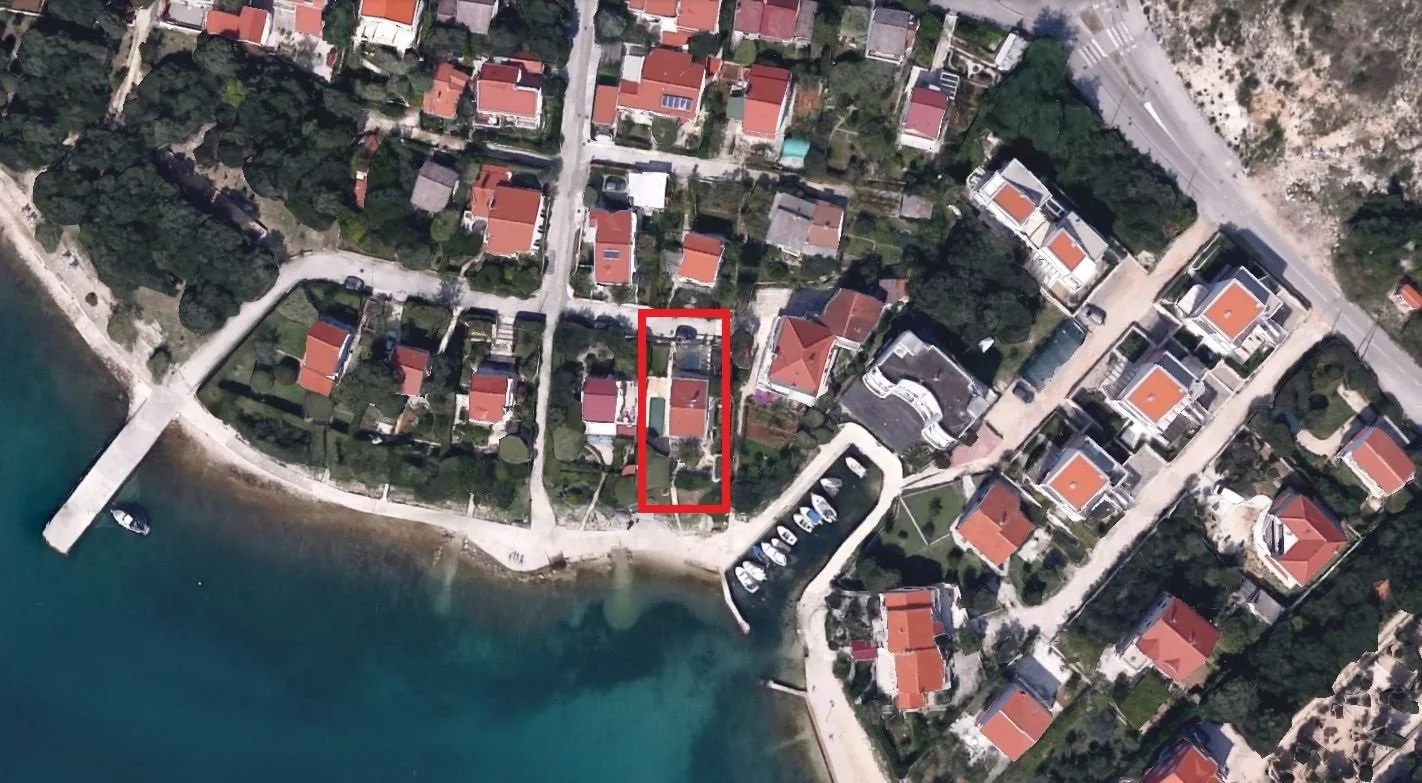
House of Karlo Ressler and Vladimir Šeks in Petrčane. Source: Google Earth, screenshot
Also lacking a use permit are the house and an auxiliary building located on a plot of land measuring a total of 1,775 m2 in Sveta Jana, which Ressler’s wife purchased last year for 25,000 euros without any mortgage registered in the encumbrance certificate. The competent office of Zagreb County confirmed to Oštro that there is no request for the issuance of a use permit for the plot in question – a document issued for a constructed or reconstructed building so that it may be used. Ressler’s office stated that the property is not in a usable condition.
The State Inspectorate responded to Oštro’s inquiry regarding any proceedings concerning the plots in Petrčane and Sveta Jana.
The State Inspectorate stated that its construction inspection has not received any complaints nor had any knowledge of violations of the Construction Act regarding the properties in Petrčane and Sveta Jana, and therefore no proceedings have been conducted. »Action concerning these plots will be included in the State Inspectorate’s work plan for the coming period in accordance with the priorities set out in the Annual Work Programme of the State Inspectorate«, they added. Incidentally, Ressler shares ownership of the house in Petrčane with the husband of his late mother, HDZ veteran Vladimir Šeks. The two also co-own an apartment in central Zagreb purchased in 2003. Šeks did not respond to Oštro’s inquiry.
Ressler and his wife also own another apartment in Zagreb, measuring 102 m2, which he purchased in 2016 for 135,000 euros without a mortgage. Six years later, his wife purchased a third apartment of 49 m2 in central Zagreb for 100,000 euros, once again without a mortgage. Ressler did not respond to Oštro’s question whether the properties were purchased with his personal funds, without loans.
In addition to this, in 2011 Ressler became the owner of a vineyard and arable land in Našice measuring 1,490 m2 through a family gift agreement, and in 2019 he inherited part of a house with a vineyard, orchard, and meadow in the same town.
According to Oštro’s investigation, Željana Zovko, an MEP since 2016, owns three properties, all of which she acquired only after beginning to work in Brussels. In 2018, she first purchased an apartment in Split for 129,000 euros, using her own funds and without any encumbrance in the land register. In its immediate vicinity, she acquired a parking space in a garage last year, which she paid 28,000 euros for. In addition to the garage space, she also bought a house measuring 43 m2 in Stari Grad on the island of Hvar last year for an undisclosed amount.
Zovko did not respond to Oštro’s questions about her assets due to, as stated by her office, security checks and protocols of the European Parliament services triggered by online threats and insults received by the representative.
Appointment to the EP and an Increase in the Number of Properties
For eight Croatian representatives in Brussels, the current 10th term of the European Parliament is not their first. Some of them have held their positions since 2013 and, compared to the last time they submitted asset declarations to the Commission in Croatia, the number of properties they own has increased.
The largest increase in assets is recorded for Biljana Borzan, one of the representatives from the seventh term in 2013, or rather her husband, physician Vladimir Borzan. He held the position of deputy director at the Osijek University Hospital Centre and has been named one of the best doctors for the past four consecutive years according to patients’ choice on the Najdoktor portal. Since 2020, Vladimir Borzan has also been the owner of a private medical centre.
The list of his assets has changed significantly compared to the data from 2014 – from the last asset declaration submitted by Biljana Borzan – when he owned only an apartment and a garage in Zagreb. In addition to these, Vladimir Borzan is now also one of the owners of several pastures in Baška on the island of Krk with a total area of 22,768 m2, which he purchased between 2018 and 2021 for more than 800,000 euros using loans.
“Oštro journalists identified 97 properties owned by MEPs – 22 of which were purchased after their move to Brussels.”
In addition, he owns a house with a yard and co-owns another one in Osijek, both purchased in 2021. He also owns three apartments in Osijek purchased in 2023, as well as business premises purchased three years earlier, in which his medical centre is located. In total, between 2020 and 2023, Biljana Borzan’s husband spent more than 250,000 euros on purchasing real estate in Osijek, without mortgage encumbrances recorded in the land registry documents.
Sunčana Glavak and Tomislav Sokol have been Members of the European Parliament since 2019.
Compared to her last asset declaration from 2019, when she owned no real estate, Glavak has, since 2022, acquired a pasture in a construction zone in Radovin near Zadar purchased for 900,000 HRK at the time, without a mortgage. Compared to Sokol’s asset declaration from 2020, last year his wife became the owner of a house with a vineyard in Zabok, which she paid 53,000 euros for using her own funds and without a mortgage, increasing the couple’s property holdings from two apartments and two garage spaces in Zagreb.
Romana Jerković first entered the European Parliament in February 2020. Land in Savudrija listed in her last asset declaration from May 2020, which had been owned by her then husband, became hers through a prenuptial agreement in August of the same year. In October of that year, she also purchased a house in Omišalj on Krk, which, according to the response given to Oštro by the competent land registry department, is currently under renovation. Since 2023, she has also owned an apartment and a garage in Istria, for which she took out a loan of 296,000 euros.
In addition to the basic monthly salary of Members of the European Parliament, which according to the Parliament’s website amounts to 8,517 euros net, three Croatian representatives also earn additional income working at various universities.
As stated in their Declarations of Members’ private interests, Glavak receives 2,000 euros per year for her work as an assistant at the University North, Sokol receives up to 4,820 euros semi-annually from the Catholic University of Croatia and up to 6,239 euros from the Zagreb School of Economics and Management for scientific and teaching activities, while Jerković earns 516 euros per month as a professor at the Faculty of Medicine in Rijeka.
Undeclared Activities
»The very fact that Members of the Croatian Parliament have publicly available and fairly detailed asset declarations, while Members of the European Parliament do not, indicates that EU institutions have significant room for improvement in terms of their ethical rules and increasing transparency«, Oriana Ivković Novokmet, Executive Director of GONG, told Oštro.
According to the Code of Conduct for Members of the European Parliament with respect to integrity and transparency, MEPs are required to complete a Declaration of Members’ private interests, a Declaration of assets, and a Declaration of awareness of conflicts of interest.
“European institutions must be more open and inclusive towards citizens – from the very process of adopting European policies, which is closed, to the obligations of representatives to publicly declare their assets.”
After news of Qatargate, a corruption scandal in which Members of the European Parliament allegedly accepted bribes from Qatar and Morocco, emerged in 2022, the European Parliament decided to move towards greater transparency and voted that Members must submit asset declarations at the beginning and end of their mandate, Ivković Novokmet explained to Oštro. However, information on the full assets of MEPs is still not publicly available.
Declarations of private interests, which include, among other things, information on ownership stakes and all indirect or direct legal interests for three years prior to submission, are publicly available, while data on assets are archived and accessible only to relevant law enforcement and judicial authorities, as stated in the Implementing Measures for the European Parliament’s Code of Conduct.
That being the case, two MEPs did not report their ownership stakes to the European Parliament. In the declaration submitted by Bartulica, his ownership of the company PPIO Consulting for business and management consultancy in the period from 2020 to 2022 is missing. In addition, he did not state anywhere that he is one of the directors of the »Croatian Education Fund«, a non-profit organisation registered in Canada whose purpose is »exclusively the advancement of education,« according to its official register. Bartulica did not respond to Oštro’s inquiry.
Romana Jerković also failed to declare ownership in the company Mazurija, which engages in tourism, hospitality, and promotional activities. According to data from the court register, the representative established the company with her former husband in 2016 and remained its co-owner until March 2023, which she did not state in her Declaration of private interests during the current or previous mandate in the European Parliament.
Jerković told Oštro that the plan for the company had been related to building a house for tourism purposes on land in Savudrija, but as this did not materialise, she transferred her shares in the company to her husband before their official divorce in 2020.
»In that sense, I remember signing a statement on the basis of which the court in Pazin issued a ruling or a decision that I no longer have any connection to that company«, added the representative, who claims she does not possess the document because her former husband retained all documentation related to the company.
Responsibility for breaches of the Code of Conduct lies with the Advisory Committee on the Conduct of Members, whose work is confidential, the European Parliament told Oštro.
In response to inquiries about potential breaches of the Code, the European Parliament stated that it does not comment on individual cases. During 2024, the Advisory Committee dealt with a total of five cases – three related to declarations of financial interests (which were replaced on 1 November 2023 by the Declaration of private interests), one concerned professional lobbying, and one related to media reports of receiving money for political activities from a third party.
»As far as the European Union is concerned, the standards required in the accession process for new Member States are significantly higher than those that apply to European institutions, which are slowly but nevertheless moving towards greater transparency. However, some rules apply to them that we do not have in Croatia, such as the obligation to declare meetings with lobbyists, which is not public information for Croatian officials«, said Ivković Novokmet.
European institutions, she added, must be more open and inclusive towards citizens – from the very process of adopting European policies, which is closed, to the obligations of representatives to publicly declare their assets.
»It is clear that the European integration process has for decades suffered from a democratic deficit, that is, from the perception among a large number of citizens that European politics takes place somewhere far away and has nothing to do with their lives, nor is it something that they can influence. This, of course, reduces the sense of connection between citizens and the political system, which is reflected in practical aspects of politics – such as voter turnout«, Dario Čepo, associate professor at the Department of Sociology at the Faculty of Law in Zagreb, explained to Oštro.
In order to restore citizens’ trust, he added, it would be more than useful to embrace the argument of radical transparency and adopt good practices from Member States at the European level.
»Improving the openness, inclusiveness, and transparency of governance in European affairs is key to encouraging citizens’ interest and engagement in EU policies, as well as strengthening their competences and knowledge about the Union – along with their commitment to the values it represents«, concluded the Executive Director of GONG.
Gaps in Old Asset Declarations
Although EP representatives are not required to report their assets to the Croatian Conflict of Interest Commission by taking up office, Oštro’s investigation identified omissions in their old asset declarations.
In addition to not declaring her co-ownership in the company Mazurija in her Declaration of private interests, Romana Jerković failed to report business shares – neither her own nor those owned by her former husband – in four asset declarations submitted to the Commission between November 2016 and May 2020.
Based on Article 41 of the Conflict of Interest Prevention Act, the Commission is authorised to initiate proceedings and sanction any established violations within 18 months of the end of a mandate, they told Oštro.
»Given that five years have passed since the end of the official’s mandate, the Commission is not authorised to conduct proceedings against her and therefore cannot sanction any established violations«, they added, concluding that proceedings could only be conducted if Jerković were to hold one of the positions prescribed by the Act, which does not include the position of an MEP.
However, in 2017 the Commission fined Jerković for incorrectly declaring a property – instead of a house with a yard in Savudrija owned by her former husband, she declared construction land. She did not correct this error in the next three asset declarations. She explained to Oštro that she was fined despite providing evidence that there is neither a house nor a yard at the address.
Although the land is recorded in documents as a house with a yard, since 2012, when the land was owned by her and her former husband, it has contained only »traces of the remains of former walls, now just piles of stones«, she said.
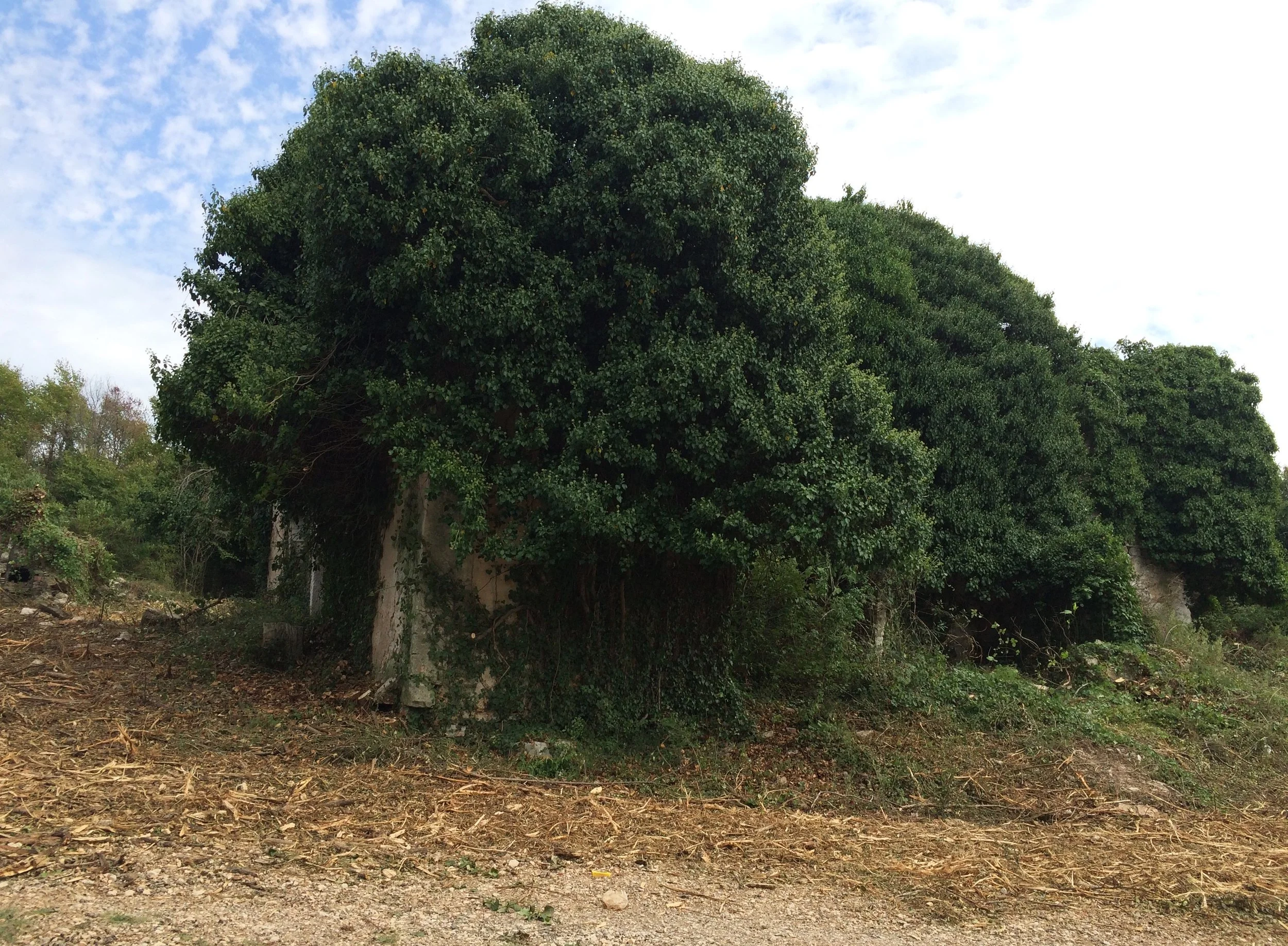
Remains of a former house on land in Savudrija owned by Romana Jerković. Source: Romana Jerković, private archive
However, for three MEPs, it has been less than 18 months since their previous office in Croatia.
Stephen Nikola Bartulica failed to declare in his asset declaration a garage space in Zagreb which he shares with his wife. Also, for a 4,128.5 m2 arable plot in Dugo Selo, which he co-owns with three other persons, he stated an incorrect area of 3,130 m2. Gordan Bosanac, on the other hand, did not declare all of his parcels, that is, the total area of land of which he is a co-owner by inheritance, as well as a loan of 200,000 euros taken out in 2023.
In his response to Oštro, Bosanac explained that he had not listed some parcels because the asset declaration form did not contain categories that would describe them. »One parcel is called ‘wasteland’. I myself do not know what it is or where to enter it. Another is referred to as ‘mill ruin’ – I was not sure where to list it, but I will now include it under ‘real estate’«, the representative said.
The loan is registered on property in his ownership because, as he explained, it was pledged as a guarantee for his sister’s housing loan. »Since I have no financial obligation under that mortgage, I intended to record it as a guarantee, and I will do so when fulfilling the regular obligation to submit an asset declaration one year after the expiry of my parliamentary mandate«, Bosanac told Oštro.
According to the rules and instructions for completing the asset declaration, officials are also required to state their memberships and functions in other legal entities, associations, and organisations – which Marko Vešligaj failed to do. Although as an MEP he stated in his Declaration of private interests that he is the president of the »Heart of Zagorje« Tourist Board (TZ Srce Zagorja) and vice-president of the SDP of Krapina-Zagorje County, he did not report the same functions in the asset declaration submitted to the Croatian Commission.
Vešligaj explained to Oštro that, since he had stated membership in the SDP at the beginning of the declaration, he did not consider it necessary to additionally list party functions. He added that he had not noticed other colleagues doing so but emphasised that this was certainly not something being concealed, as the information is publicly available.
Regarding his role as president of the »Heart of Zagorje« Tourist Board, he explained that the board covers several local self-government units, and its presidents are elected from among mayors and municipal heads for a period of one year. Accordingly, as Mayor of Pregrada, he held this position from 10 July 2024 until 4 June 2025, that is, until the expiry of his mayoral mandate. However, he did not explain why he failed to include this role in the declaration submitted to the Commission in January.
The Commission told Oštro that it would open cases against the three named officials and examine the circumstances, and it would inform them in due course of its decision on whether to initiate proceedings.